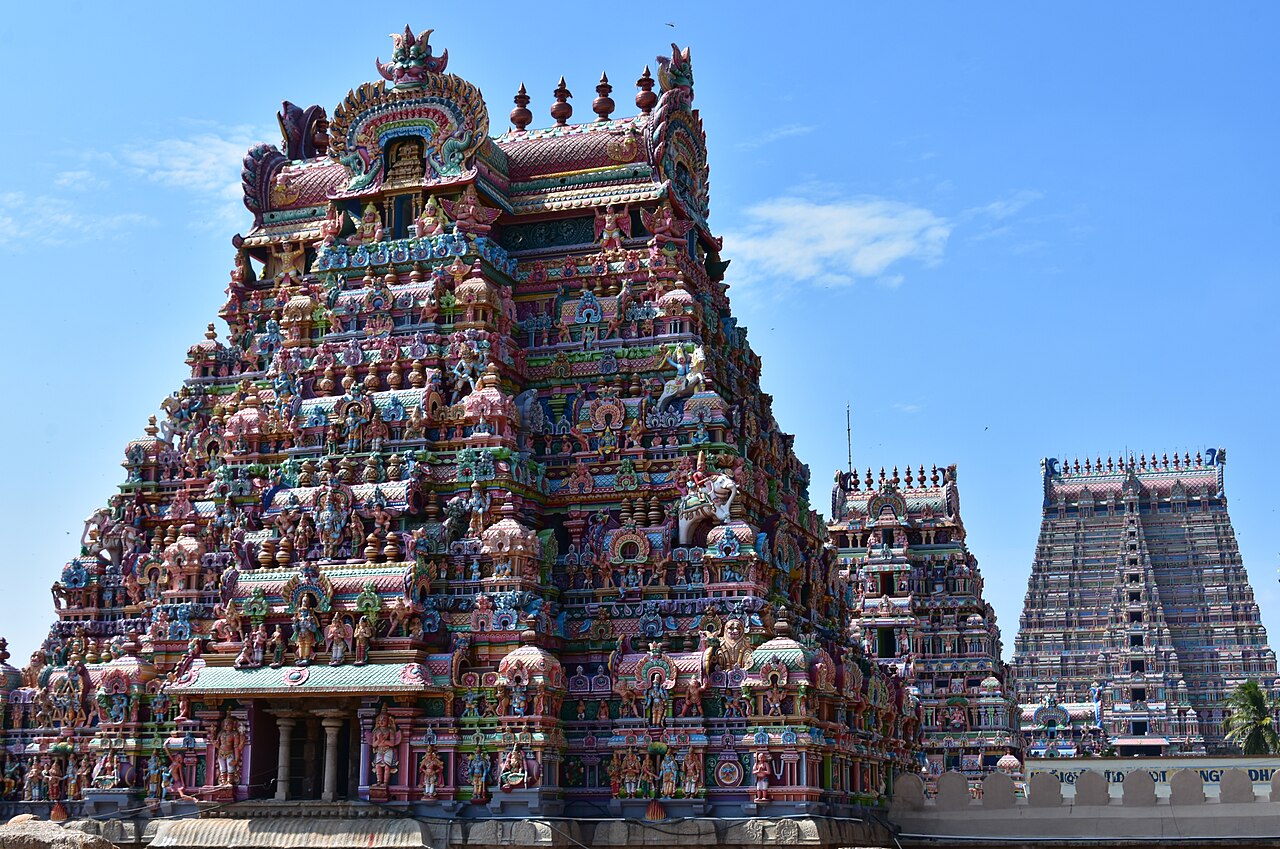
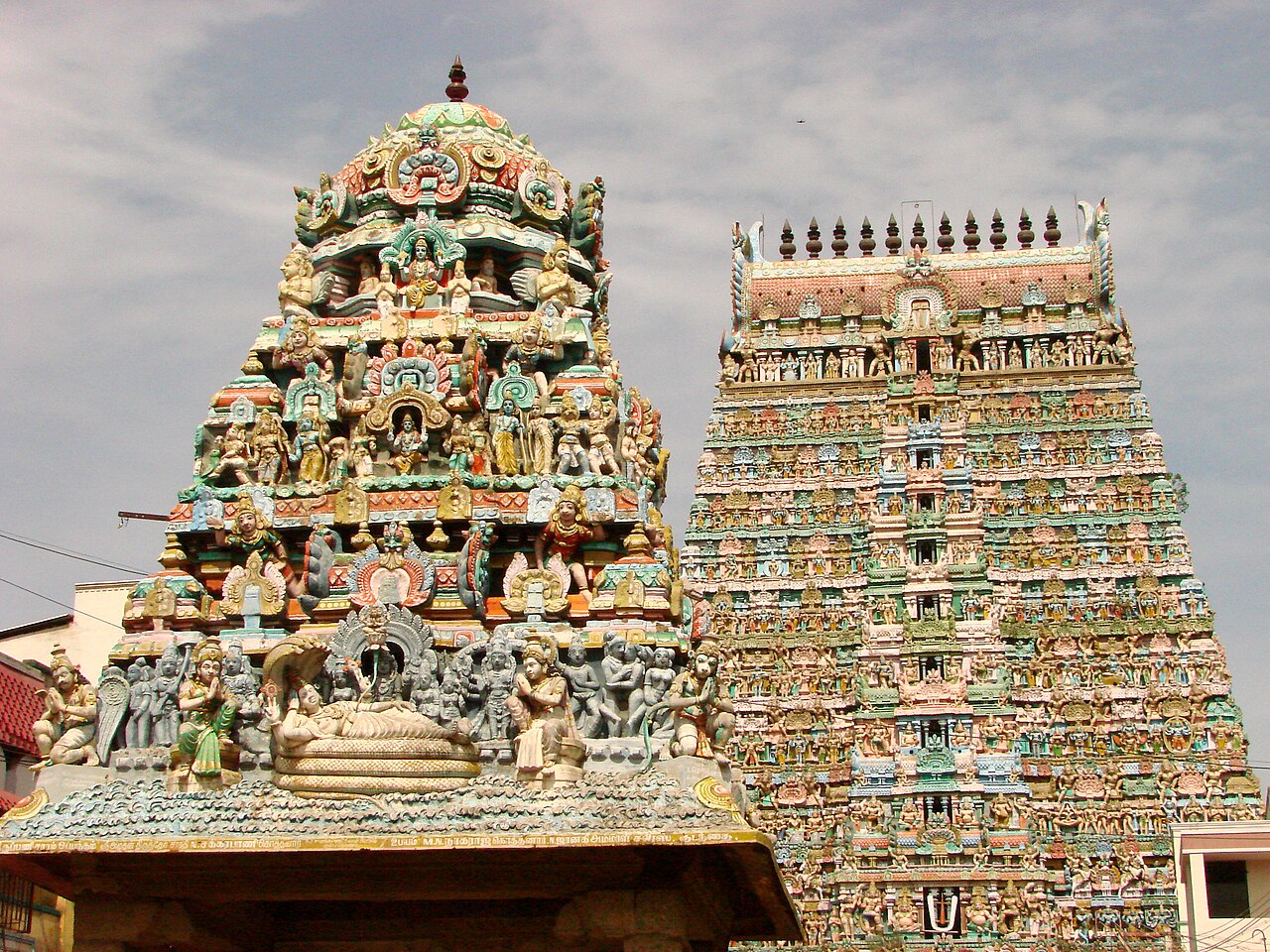
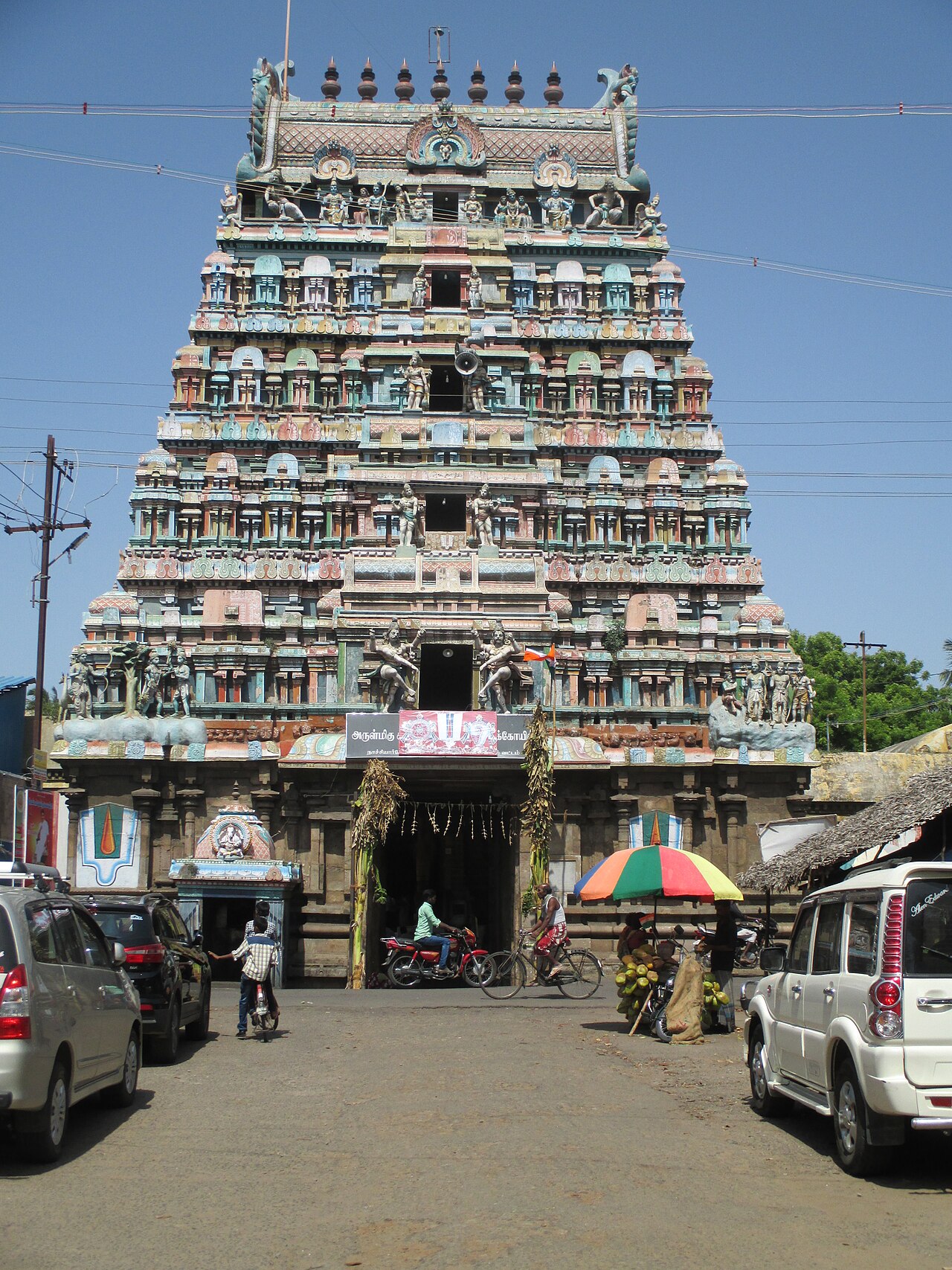
Oppiliappan Temple, Thiruvinnagar
Thiru Vinnagar
Raji.srinivas · CC BY-SA 3.0 · source
Known as the Tirupati of the south; food offerings here are traditionally prepared without salt.
Sthala Purāṇam
The sthala puranam of Oppiliappan Temple at Thiruvinnagar (Thirunageswaram, near Kumbakonam) centres on the sage Markandeya, who, as told in the Brahmanda Purana, undertook a thousand years of severe penance desiring that Lakshmi be born as his daughter and that Vishnu himself become his son-in-law. Pleased, Lakshmi appeared as an infant beneath a tulasi plant; Markandeya recognised her and reared her, worshipped here as Bhumi Devi. When the girl reached adolescence in the month of Panguni under the asterism Shravana, Vishnu came as an aged old man and sought her hand. Markandeya protested that the child was too young and did not even know to season food with proper salt. The old man replied that he would gladly accept her cooking without salt rather than depart unwed. Perceiving through yogic vision that the elder was Narayana himself, Markandeya gave his daughter in marriage. In keeping with this episode, the temple's neivedyam is to this day prepared entirely without salt, and the Lord is therefore called Oppiliappan (Uppiliappan, the lord without salt); he is also known as Thiruvinnagarappan. The kshetra of Thiruvinnagar (vinnagar, celestial city) is held to be as sacred as Vaikuntha itself. The vimana is named the Suddhananda Vimanam (pure bliss), and the sacred tank is the Ahoraathra Pushkarani, where a king cursed into the form of a bird is said to have regained his original shape. Among the Divya Desams, Oppiliappan is celebrated as a place where worship requires no costly offerings, for the salt-less consecration is itself the mark of the Lord's grace.
Mangalāśāsanam — the Āḻvār pāsurams
The Lord Oppiliappan (Thiruvinnagarappan) with Bhumi Devi (Bhoomidevi Nachiyar) of Thiru Vinnagar is glorified by:
Thiruvinnagar (Oppiliappan / Uppiliappan temple at Thirunageswaram near Kumbakonam), the 13th Divya Desam, where the Lord Thiruvinnagarappan stands with Bhumi Devi (Ennai Thaayar), enjoys a rich mangalasasanam. Nammalvar dedicates a full decade of 11 pasurams in his Thiruvaaymozhi (decade 6.3, beginning 'nalguravum selvum'), wondering at the Lord who holds all contrary entities — poverty and wealth, hell and heaven, poison and nectar — as his own forms, whom he beheld in prosperous Thiruvinnagar. Thirumangai Alvar sings a decade in his Periya Thirumozhi (decade 6.3) plus additional individual verses in his other prabandhams, and the early Alvars Poigai Alvar and Pey Alvar each contribute verses in the Iyarpa, the whole mangalasasanam totalling about 47 pasurams.
நல்குரவும் செல்வும் நரகும் சுவர்க்கமும் ஆய், வெல்பகையும் நட்பும் விடமும் அமுதமும் ஆய், பல்வகையும் பரந்த பெருமான் என்னை ஆள்வானை, செல்வம் மல்கு குடித் திருவிண்ணகர்க் கண்டேனே.
nalguravum selvum naragum suvarggamum Ay / vel pagaiyum natpum vidamum amudhamum Ay / pal vagaiyum parandha perumAn ennai ALvAnai / selvam malgu kudith thiruviNNagark kaNdEnE
The supreme Lord who pervades all things in their manifold pairs — poverty and wealth, hell and heaven, conquering enmity and friendship, deadly poison and life-giving nectar — having all these contrary entities as his very forms; that Lord who rules over me, I have now seen (and attained) in Thiruvinnagar, the town teeming with prosperity and with the wealth of devotees who relish God.
Tamil text & meaning sourced from divyaprabandham.koyil.org and other Śrī Vaiṣṇava authorities — please cross-check the linked source for the canonical reading.
Read the pāsurams ↗Plan your visit
📍 10.96156, 79.43159
Routes, distances, hotels and restaurants open in Google Maps with live data. Build a phased pilgrimage plan →