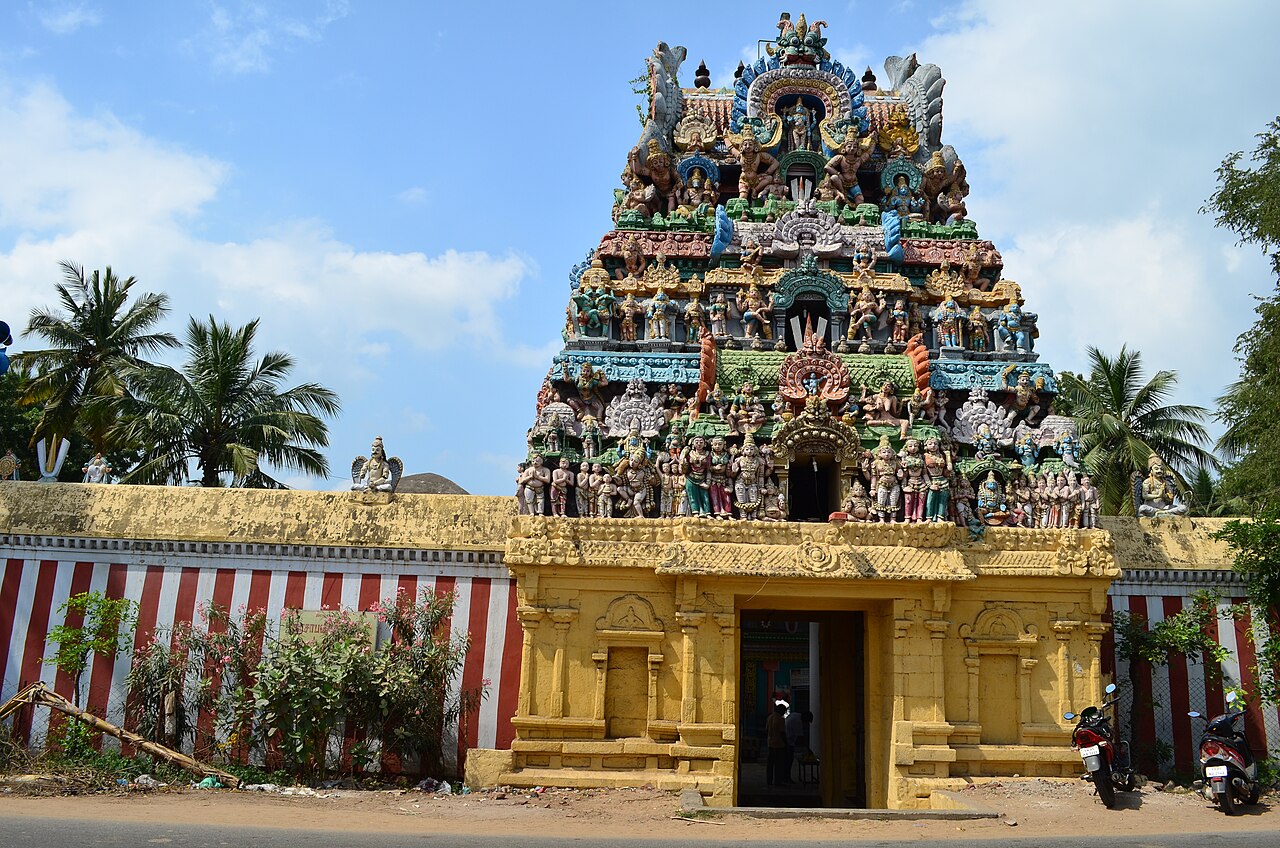
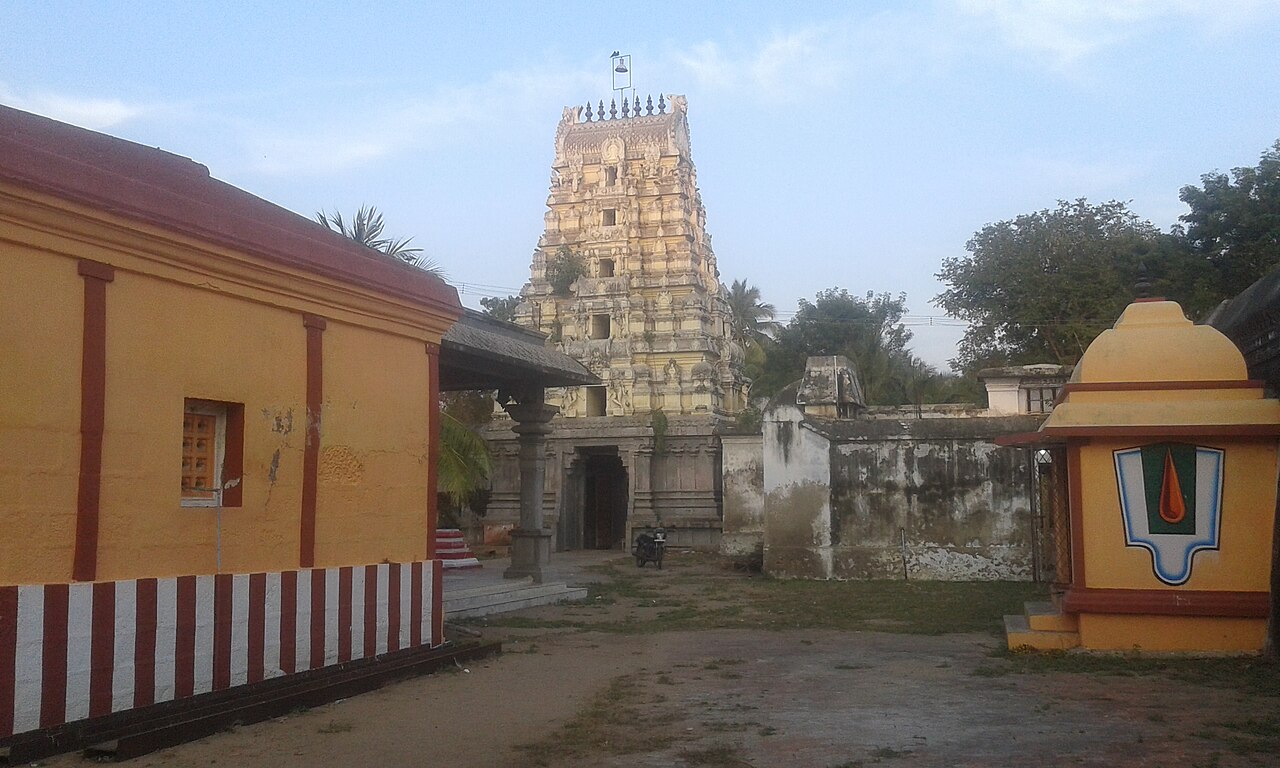
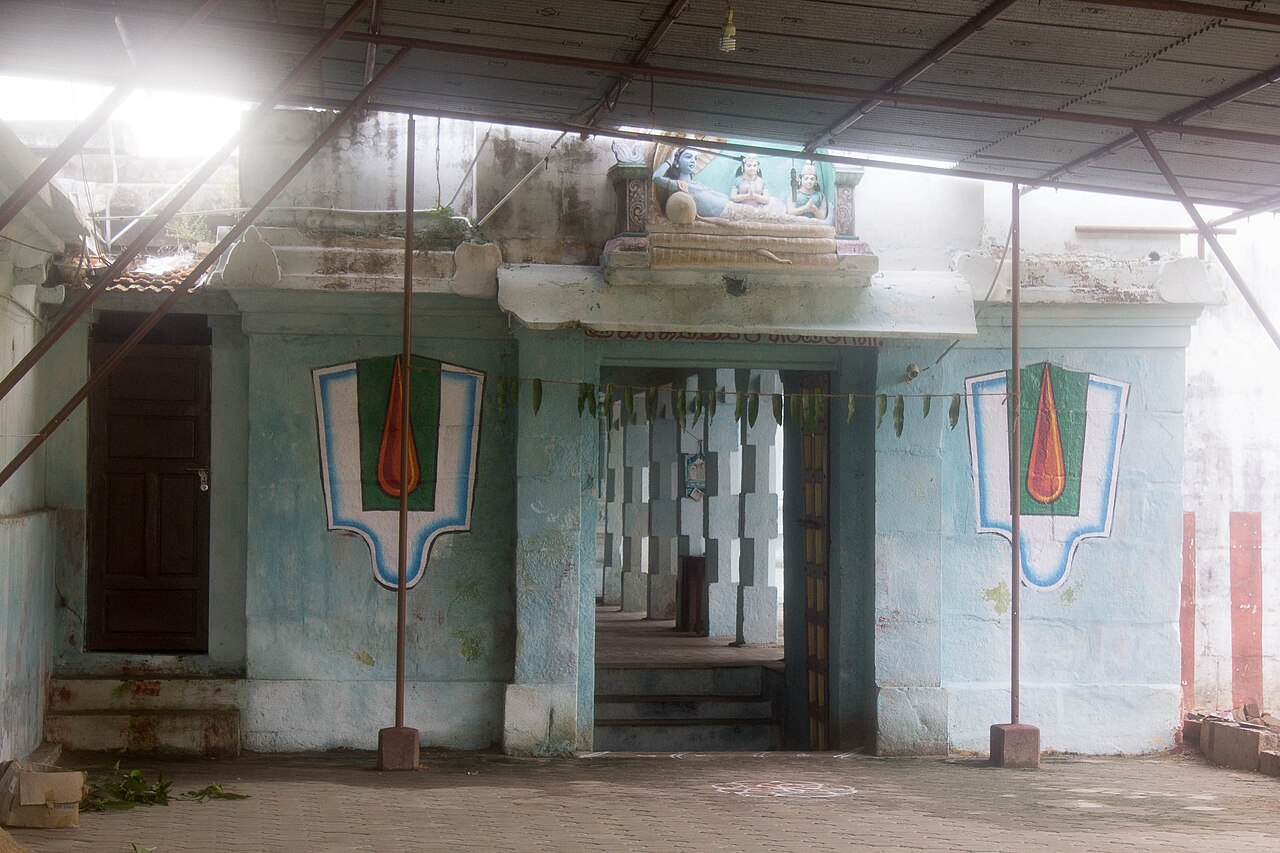
Thanjai Mamani Koil (Neelamega Perumal Temple), Thanjavur
Thiru Thanjai Maamani Koil
Ssriram mt · CC BY-SA 4.0 · source
A complex of three shrines counted together as a single Divya Desam.
Sthala Purāṇam
Thanjai Mamani Koil at Thanjavur is unique among the hundred and eight Divya Desams, being a single Divya Desam comprising three adjacent Vishnu shrines near the banks of the Vennaru river. According to the sthala puranam, drawn from the Brahmanda Purana, the asuras Thanjakan and Thandakan, together with a third demon, having won boons from Lord Shiva, grew mighty and tormented the sage Parashara and other rishis at their penance. Vishnu intervened in distinct forms: he slew Thanjakan with the Sudarshana Chakra; taking the shape of a Yali, a mythical lion-beast, he destroyed one of the demons; and assuming the Varaha form he pursued Thandakan, who fled toward Srimushnam. The dying Thanjakan pleaded for grace, and Vishnu granted the boon that the city be named after him, and hence it became Thanjavur. The three shrines that together constitute the one Divya Desam are dedicated to Neelamegha Perumal, with the Thayar Sengamalavalli in a separate sannidhi; to Manikundra Perumal, the Lord and his consort enshrined in a single sanctum; and to Veera Narasimha Perumal, the last also called Thandarai Vinnagaram or Thanjaiyali Koil, recalling the Yali avatara. This trinity of temples is glorified in the pasurams of Thirumangai Alvar.
Mangalāśāsanam — the Āḻvār pāsurams
The Lord Neelamegha Perumal with Sengamalavalli (Senkamala Thaayaar) of Thiru Thanjai Maamani Koil is glorified by:
Thanjai Mamani Koil at Thanjavur is unique among the 108 Divya Desams: it is a single Divya Desam constituted by three adjacent Vishnu shrines (Neelamega Perumal with Thayar Sengamalavalli, Manikundra Perumal, and Veera Narasimha Perumal / Thandarai Vinnagaram), and the Alvars' pasurams praise the three together rather than naming a single shrine. It received the mangalasasanam (benediction in verse) of three Alvars. Thirumangai Alvar sang it in Periya Thirumozhi: in pasuram 1.1.6 (NDP verse 953) he explicitly worships at 'thanjai mamanik koyil', describing it as girt with fragrant groves and lofty ramparts, and declares that there he found the saving name 'Narayana' — by temple tradition his Thanjai verses refer to the Maamanikoil (Manikundra) shrine. Bhoothath Alvar, the second of the three Mudhal Alvars, names Thanjai in Irandam Thiruvandhadhi verse 70, listing it among the foremost abodes of the Lord (alongside Srirangam, Thiruvengadam, the Ocean of Milk, Mahabalipuram, Thirukkovalur and Kumbakonam), with the devotees' own hearts ranked first; tradition links his Thanjai reference to the Veera Narasimha shrine. Nammalvar is counted among the temple's Alvars through his 'madal' decad (Thiruvaymozhi 5.3), where the heroine's longing for the blemishless Lord is identified by tradition with Manikundra Perumal of Thanjai, though no verse there names the temple in plain place-name form. The two verbatim Tamil verses cited (Periya Thirumozhi 1.1.6 and Irandam Thiruvandhadhi 70) are sourced exactly from divyaprabandham.koyil.org, the standard Sri Vaishnava authority; the Nammalvar attribution is documented but its exact verse mapping is uncertain.
empiran endhai ennudaich chuRRam / enakkarasu ennudai vaNal / ambinal arakkar verukkoLa nerukki / avaruyir seguththa em aNNal / vambulanjOlai mamadhiL thanjai / mamaNik kOyilE vaNangi / nambigaL! uyya nan kaNdu koNdEn / narayaNa ennum namam
He is my benefactor, my father, all my kinsfolk, my king and my very lifespan; my Lord who pressed upon the rakshasas with his arrows so that they trembled in terror and destroyed their lives. Worshipping that Lord who resides at Thanjai Mamani Koil, surrounded by fragrance-laden groves and lofty ramparts, O devotees, I have, for my redemption, found and grasped the holy name 'Narayana'.
thamaruLLam thanjai thalaiyarangam thaNkal / thamaruLLum thaN poruppu vElai thamaruLLum / mamallai kOval madhiL kudandhai enbarE / Evalla endhaikku idam
The abodes of my Lord, who is capable of any deed (to protect his devotees), are said to be: the hearts of his devotees (foremost of all), Thanjai (Thanjai Mamani Koil), Thalai-arangam (the foremost Srirangam), Thiruthankal, the cool hill of Thiruvengadam, the Ocean of Milk (Thiruparkadal), Mamallai (Thirukkadalmallai/Mahabalipuram), Koval (Thirukkovalur), and walled Kudandhai (Kumbakonam).
More verses & references (1)
- In the 'madal' decad (Thiruvaymozhi 5.3), Nammalvar sings in the bhava of the heroine (parankusa nayaki) who, overwhelmed by love for the blemishless Lord, vows to undertake 'madal oorthal' (the bold public love-protest of classical Tamil tradition) to attain him. Sri Vaishnava tradition and the temple identify the Lord she yearns for here with the Manikundra Perumal shrine of Thanjai Mamani Koil; the temple counts Nammalvar among its mangalasasanam Alvars on this basis. No single verse of decad 5.3 names the temple in its place-name form, so the exact verse text is not quoted here. — Nammalvar, Thiruvaymozhi Decad 5.3 (the 'madal' decad); the Thanjai / Manikundra Perumal association is attributed by tradition · source ↗
Tamil text & meaning sourced from divyaprabandham.koyil.org and other Śrī Vaiṣṇava authorities — please cross-check the linked source for the canonical reading.
Read the pāsurams ↗Gallery
.jpg)
.jpg)
.jpg)
.jpg)
Tap an image to view it larger — use ‹ › to browse, ✕ to close. Images via Wikimedia Commons.
Plan your visit
📍 10.81570, 79.13860
Routes, distances, hotels and restaurants open in Google Maps with live data. Build a phased pilgrimage plan →